
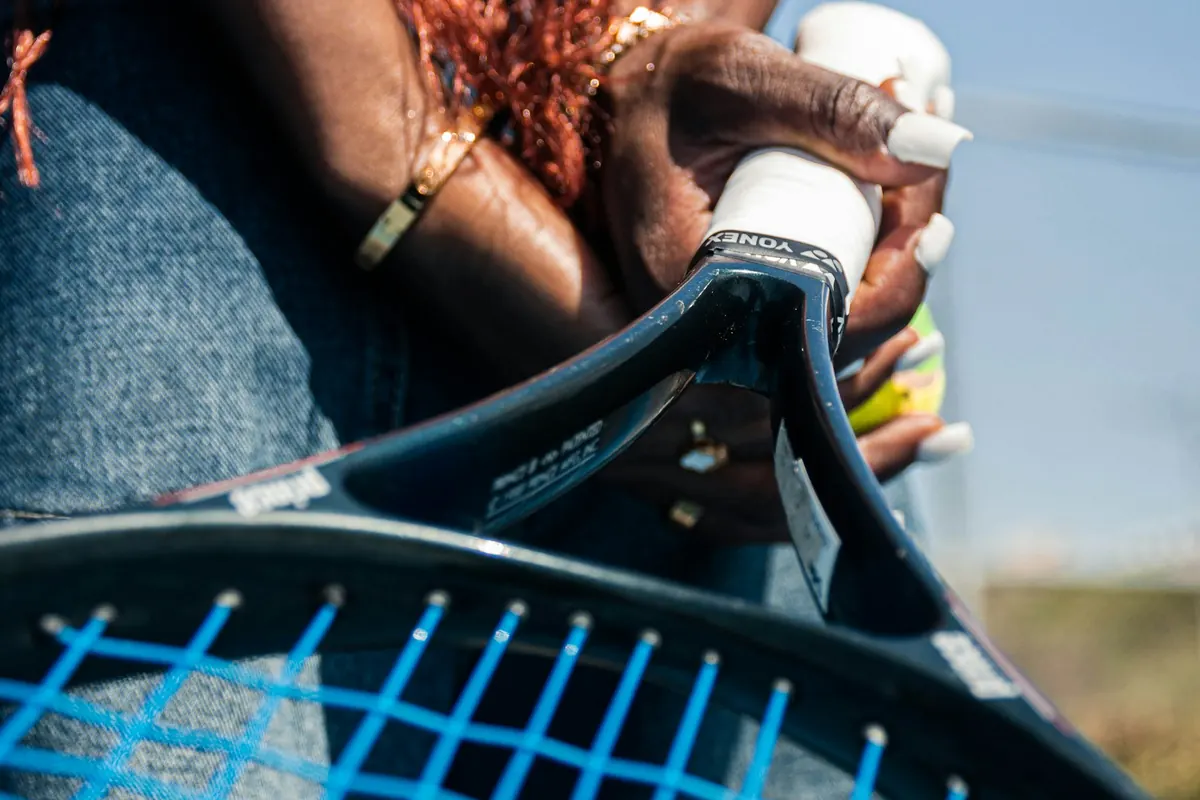
Look closely at a professional's racket and you will often see a bright white or black tape over the handle. That is an overgrip — a thin wrap that costs very little, takes two minutes to change and makes a real difference to how securely and comfortably you hold the racket.
Overgrip vs replacement grip
| Replacement (base) grip | Overgrip | |
|---|---|---|
| What it is | Cushioned layer glued to the handle | Thin tape wrapped over the base grip |
| Thickness | Thicker, cushioned | Very thin |
| Main job | Comfort, shock absorption, handle shape | Tack, sweat absorption, protecting the base grip |
| Change | Rarely — when worn or hard | Often |
| Cost | Higher | Low |
Most players keep the factory base grip and simply change overgrips. Replace the base grip only when it is worn, compressed or you want to change its feel.
Types of overgrip
- Tacky: a slightly sticky surface for a secure hold. The most popular choice for most players.
- Dry: a matte, absorbent surface that gets better as it soaks up sweat. Ideal for sweaty hands, heat and humidity.
- Perforated / cushioned: small holes or extra thickness for sweat absorption and a softer feel.
Overgrips and grip size
Every layer on the handle makes it a little thicker. As a rule of thumb, one overgrip adds about half a grip size and two overgrips about a full size. That is useful:
- If you are between two sizes, buy the smaller handle and build it up with an overgrip.
- If a racket feels too thin, add a second overgrip before buying a new one.
- A handle that is too thin makes you squeeze harder, which can contribute to elbow problems — see our arm-friendly setup guide.
Measure your size properly in the tennis grip size guide.
How to wrap an overgrip
- Remove the old overgrip, keeping the base grip in place.
- Peel the backing from the tapered end of the new overgrip.
- Start at the butt cap, with the tapered end against the bottom of the handle.
- Wrap upwards, overlapping each turn slightly and keeping steady tension.
- Stop just below the throat, cut off any excess at an angle, and secure it with the finishing tape supplied.
Direction matters: right- and left-handers usually wrap in opposite directions, so the edges of the tape don't catch on your palm. Many overgrip packs show the right direction — if the edges feel raised under your hand, rewrap the other way.
When to change it
- It feels smooth, shiny or hard.
- It no longer absorbs sweat and the racket slips.
- It is torn, dirty or unravelling at the top.
- As a guide: every 4–10 hours of play for regular club players, sooner in heat.
Keep a few spare overgrips in your bag — they weigh nothing and can save a match on a hot day. See the rest of the kit in tennis bag essentials.
Frequently asked questions
What is the difference between an overgrip and a replacement grip?
A replacement grip (or base grip) is the thicker, cushioned layer that comes on the racket and is glued to the handle. An overgrip is a thin, cheap tape wrapped over it to add tack, absorb sweat and protect the base grip.
Does an overgrip change grip size?
Yes. A single overgrip adds roughly 1/16 inch (about 1.5 mm) to the handle's circumference, about half a grip size. Two overgrips add roughly one full size.
Tacky or dry overgrip: which is better?
Tacky overgrips give a sticky feel that most players like in normal conditions. Dry overgrips absorb sweat and feel better for players whose hands sweat a lot or who play in hot, humid weather.
How often should I change my tennis overgrip?
Many club players change it every 4 to 10 hours of play; professionals change it every match or even during a match. Change it as soon as it feels smooth, hard, shiny or slippery.