
Tennis is one of the few sports whose playing surface changes the game completely. The same serve that wins a free point on grass can come back with interest on clay. Understanding the main surfaces helps you follow the professional season — and choose the right shoes, strings and tactics for your own court.
The four main surfaces at a glance
| Surface | Speed | Bounce | Favours | Grand Slam |
|---|---|---|---|---|
| Clay | Slow | High | Spin, patience, defence, fitness | Roland-Garros |
| Hard court | Medium (varies) | Medium, very consistent | All-round players | Australian Open, US Open |
| Grass | Fast | Low, skidding | Big serves, slices, net play | Wimbledon |
| Indoor (hard or carpet) | Fast to medium | Low to medium | Serve and first-strike tennis | — |
The International Tennis Federation classifies court pace in five categories, from 1 (slow) to 5 (fast). The categories describe how much the surface slows the ball and how high it bounces.
Clay courts
Clay courts are made of crushed brick, stone or shale on a firm base. Red clay dominates in Europe and South America; green clay (a crushed basalt mix, often called Har-Tru) is common in parts of the United States.
- Slow and high-bouncing: the loose surface grips the ball, taking pace off it and kicking it up.
- Long rallies: it is harder to hit winners, so consistency, topspin and fitness are rewarded.
- Sliding: players slide into shots, which takes practice and the right shoes.
- Kind to the body: the softer surface is easier on joints than hard courts.
- Maintenance: courts need regular watering, brushing and line care.
The professional clay season runs mainly in spring, culminating at Roland-Garros in Paris.
Grass courts
The original tennis surface — the sport's full name is lawn tennis. Grass is now rare outside the UK and a few clubs worldwide because it is expensive to maintain.
- Fast and low: the ball skids and stays low, especially slices.
- Short points: serves are hard to return; serve-and-volley and flat hitting are effective.
- Changing conditions: courts wear during a tournament, especially around the baseline, and can be slippery when damp.
- Short season: the professional grass swing lasts only a few weeks around Wimbledon.
Hard courts
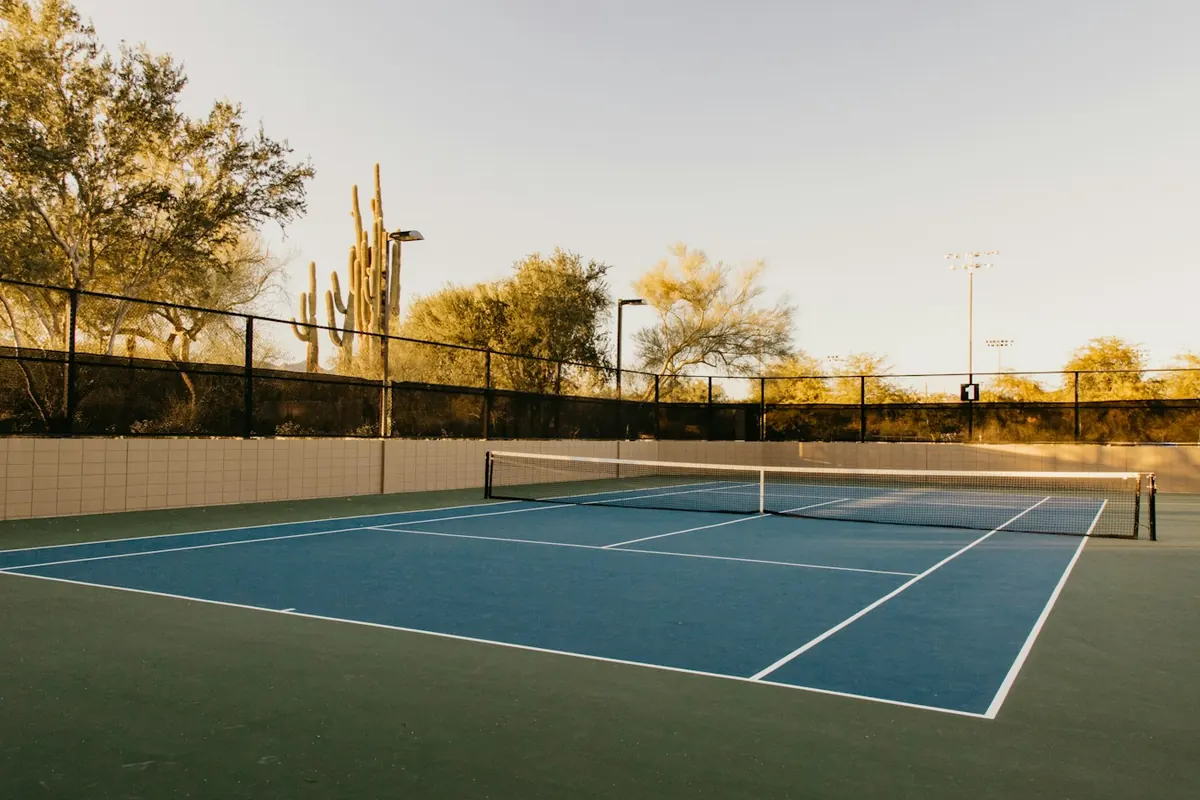
Hard courts are concrete or asphalt covered with an acrylic coating. Adding more or less sand to the top layer makes the court slower or faster, which is why hard courts vary so much from one venue to another.
- Predictable bounce: the most consistent surface, so it suits all styles.
- Medium pace on average, but some are quick and others slow and gritty.
- Tough on bodies and shoes: the surface does not absorb impact and wears outsoles quickly.
- Low maintenance: the most common surface at public courts and clubs worldwide.
Most of the professional season is played on hard courts, including the Australian Open and US Open. You can see which surface each event uses in our tennis calendar.
Indoor courts and other surfaces
- Indoor hard and carpet: no wind or sun, often fast. Many autumn professional events are indoors.
- Artificial grass with sand: common at clubs in the UK and Northern Europe; plays somewhere between clay and grass and needs omni or clay-style shoes.
- Synthetic clay: looks like clay with lower maintenance; plays slightly faster than real clay.
Adapting your game: on clay, add margin over the net and use topspin; on grass, bend low, shorten your swing and come forward; on hard courts, play your normal game but warm up well — the surface is the least forgiving on knees and ankles.
Equipment by surface
- Shoes: each surface needs a different outsole — herringbone for clay, durable rubber for hard courts, nubs for grass. See tennis shoes by surface.
- Balls: extra-duty felt for hard courts, regular duty for clay and indoors. See our tennis balls guide.
- Strings: on slow clay, a little more spin helps; on fast courts, control matters more. A couple of pounds of tension can make the difference — see the tension chart.
Why surfaces matter when following the tours
Player results often swing with the surface. Clay specialists can climb the rankings in spring; big servers often do their best work on grass and fast indoor courts. When you check the live scores or the rankings, keep the surface in mind — it explains many upsets. For court sizes and line markings, see tennis court dimensions.
Frequently asked questions
Which tennis surface is the fastest?
Grass is traditionally the fastest outdoor surface, with a low, skidding bounce. Some indoor hard courts and carpet surfaces can be just as fast. Clay is the slowest.
Which Grand Slam is played on which surface?
The Australian Open and US Open are played on hard courts, Roland-Garros (the French Open) on red clay, and Wimbledon on grass.
Is clay or hard court better for beginners?
Both work well. Clay is slower and kinder to the joints, giving beginners more time; hard courts are more common, cheaper to maintain and give a predictable bounce.
What is court pace rating?
The ITF classifies court surfaces by how much they slow the ball, from category 1 (slow) to category 5 (fast). Most clay courts fall in the slow categories and most grass courts in the fast ones, with hard courts spread across the middle.