
Whether you are settling an argument at the club, planning a court or just curious, here are the official dimensions of a tennis court in metres and feet, the names of every line, and the space needed around the playing area. All measurements follow the International Tennis Federation's Rules of Tennis.
Tennis court dimensions at a glance
| Measurement | Metres | Feet |
|---|---|---|
| Court length (baseline to baseline) | 23.77 m | 78 ft |
| Doubles width | 10.97 m | 36 ft |
| Singles width | 8.23 m | 27 ft |
| Doubles alley (each side) | 1.37 m | 4.5 ft |
| Net to service line | 6.40 m | 21 ft |
| Service line to baseline | 5.485 m | 18 ft |
| Service box width | 4.115 m | 13.5 ft |
| Net height at centre | 0.914 m | 3 ft |
| Net height at posts | 1.07 m | 3.5 ft |
| Net posts outside the doubles sideline | 0.914 m | 3 ft |
The lines of a tennis court
- Baselines: the lines at each end of the court. Players serve from behind them.
- Centre mark: a short mark in the middle of each baseline that divides the two halves for serving.
- Singles sidelines: the inner long lines, used in singles.
- Doubles sidelines: the outer long lines, used in doubles. The strip between the two sidelines is the alley (or tramlines in British English).
- Service lines: parallel to the net, 6.40 m (21 ft) from it, marking the back of the service boxes.
- Centre service line: runs from the net to each service line, splitting the service area into the deuce (right) and advantage (left) boxes.
Lines may be between 2.5 and 5 cm (1–2 in) wide, except the baselines, which may be up to 10 cm (4 in) wide. All measurements are taken to the outside of the lines, and the lines are part of the court: a ball touching the line is in.
Singles vs doubles: in singles, the alleys are out. In doubles, they are in during rallies — but the serve must still land in the service box, which uses the singles sideline.
The net
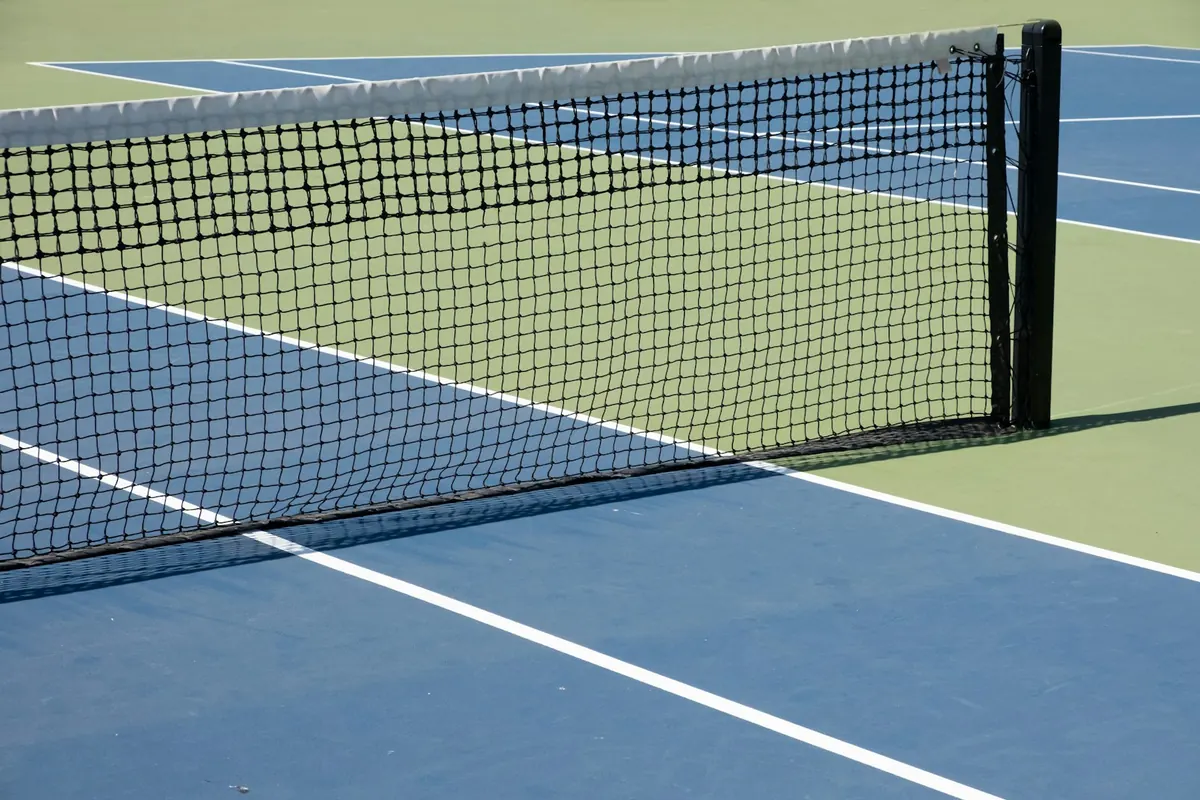
The net stretches across the full width of the court and hangs from a cord or metal cable attached to two posts. It must be 0.914 m (3 ft) high at the centre, where a white centre strap holds it down, and 1.07 m (3 ft 6 in) at the posts. When a singles match is played on a doubles court with a doubles net, the net is raised to 1.07 m at two "singles sticks" placed 0.914 m (3 ft) outside each singles sideline.
Space around the court
The playing lines are only part of the story: players need room to run. The ITF recommends at least 6.40 m (21 ft) behind each baseline and 3.66 m (12 ft) beside each doubles sideline for international play. That gives a recommended total area of about 36.6 × 18.3 m (120 × 60 ft). Club and public courts often have a little less space, especially beside the sidelines.
| Area | Metres | Feet |
|---|---|---|
| Playing area (doubles) | 23.77 × 10.97 | 78 × 36 |
| Recommended total area | 36.58 × 18.29 | 120 × 60 |
| Playing surface (doubles) | about 261 m² | 2,808 sq ft |
Junior and short courts
Young children start on smaller courts with slower balls: the red stage court is around 11–12 m long and the orange stage court around 18 m, before moving to the full court with green and then yellow balls. Our tennis balls guide and junior racket size guide explain the stages.
Tennis court vs padel court
A padel court is 20 × 10 m and enclosed by walls — about 77% of the area of a tennis doubles court, with no space needed outside the walls. See padel vs tennis for a full comparison.
Orientation and surface
Outdoor courts are ideally oriented roughly north–south so that the sun does not shine straight into a player's eyes for long periods. The surface itself — clay, grass or hard court — changes how fast the game plays; see tennis court surfaces explained. And if you want to know how points are counted on that court, read tennis scoring explained.
Frequently asked questions
How big is a tennis court?
The playing area is 23.77 m (78 ft) long and 10.97 m (36 ft) wide for doubles, or 8.23 m (27 ft) wide for singles. With the recommended space around it, the total area is about 36.6 × 18.3 m (120 × 60 ft).
How high is a tennis net?
The net is 0.914 m (3 ft) high at the centre, held by a centre strap, and 1.07 m (3 ft 6 in) at the posts.
How long is the service box?
Each service box is 6.40 m (21 ft) deep from the net to the service line and 4.115 m (13.5 ft) wide, which is half the singles width.
Is the line part of the court?
Yes. The lines belong to the area they mark, so a ball that touches any part of the line is in.