
A padel court is small, enclosed and full of glass. Its dimensions are standardised by the International Padel Federation (FIP), which is why the game feels the same in Madrid, Dubai or a club near you. Here are the key measurements in metres and feet.
Padel court dimensions at a glance
| Measurement | Metres | Feet (approx.) |
|---|---|---|
| Court length | 20 m | 65.6 ft |
| Court width | 10 m | 32.8 ft |
| Net to service line | 6.95 m | 22.8 ft |
| Service line to back wall | 3 m | 9.8 ft |
| Service box width | 5 m | 16.4 ft |
| Net height (centre) | 0.88 m | 2.9 ft |
| Net height (posts) | 0.92 m | 3 ft |
| Playing area | 200 m² | 2,153 sq ft |
The lines
- Service lines: parallel to the net, 6.95 m from it, on each side.
- Centre service line: runs from the net to each service line, dividing the two service boxes.
- There are no sidelines or baselines: the walls are the boundaries.
Lines are typically 5 cm wide. A serve that lands on the service line or centre line is in.
The walls
The walls are what make padel different from every other racket sport — and they follow a precise layout.
- Back walls: 3 m of tempered glass (or solid wall on some courts), with metal mesh above, for a total height of about 4 m.
- Side walls: glass panels next to each back wall — typically 3 m high for the first 2 m, then stepping down to 2 m for the next 2 m — with metal mesh covering the middle of the court.
- Access: openings in the side mesh near the net let players enter and, on some courts, play the ball outside the court.
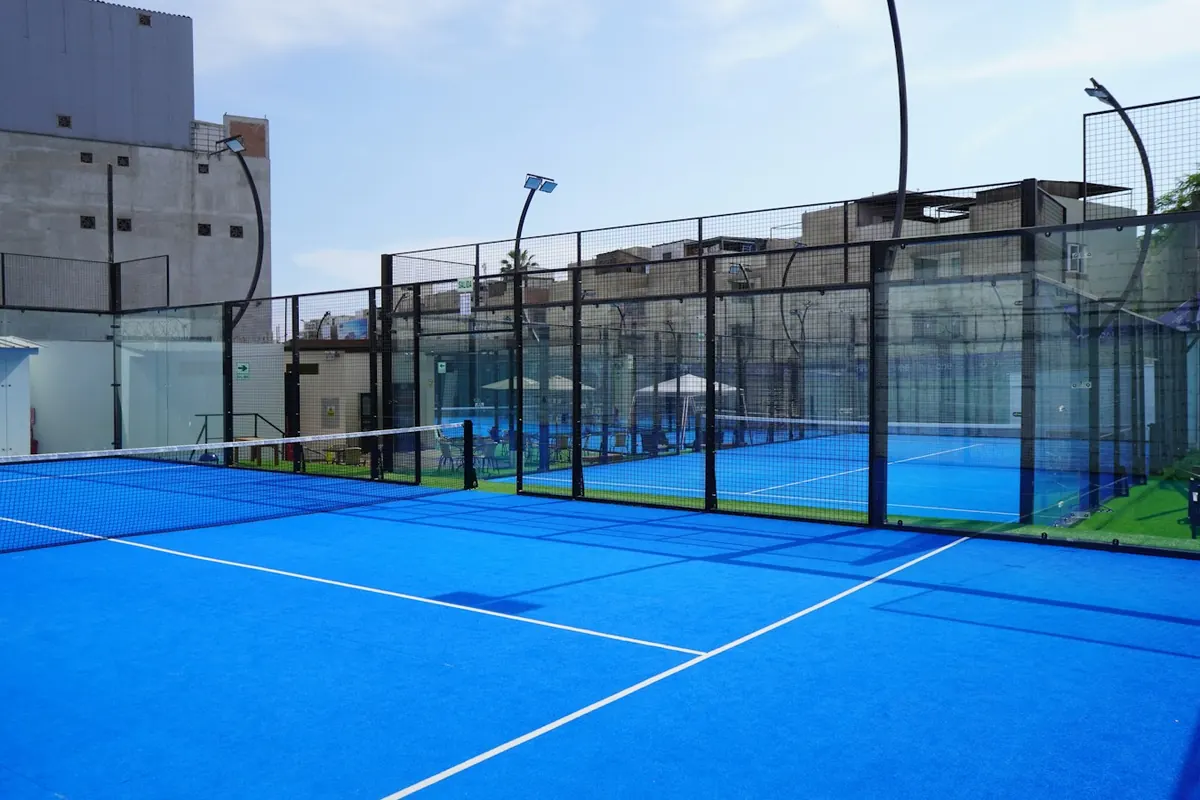
The ball behaves differently off the glass (a predictable bounce) and the mesh (an unpredictable one) — and the rules treat them differently on the serve. See padel rules explained.
Height and surface
- Clear height: indoor courts need plenty of space above for lobs — at least 6 m is commonly recommended, more for competition courts.
- Surface: usually artificial grass filled with sand, sometimes concrete or synthetic surfaces. Sand-filled grass needs shoes with an omni or herringbone sole — see padel shoes.
Padel vs tennis court
| Padel | Tennis (doubles) | |
|---|---|---|
| Playing area | 20 × 10 m | 23.77 × 10.97 m |
| Space needed incl. run-off | about 21 × 11 m | about 36.6 × 18.3 m |
| Net height (centre) | 0.88 m | 0.914 m |
| Walls | Yes — part of play | No |
Because one tennis court site can hold roughly three padel courts, many clubs have converted tennis courts. See our tennis court dimensions guide for the full tennis measurements and padel vs tennis for how the games compare.
Frequently asked questions
How big is a padel court?
The playing area is 20 m long and 10 m wide (65.6 × 32.8 ft), enclosed by walls. That is roughly the area of a tennis doubles court minus the space around it — a padel court takes about a third of the land needed for a full tennis court with run-off.
How high is a padel net?
The net is 0.88 m (about 2 ft 10 in) high at the centre and 0.92 m at the posts — slightly lower than a tennis net.
How high are padel court walls?
Back walls are usually 3 m of glass with about 1 m of metal mesh above (4 m in total). Side walls have glass sections next to the back walls and mesh along the middle, typically up to 3–4 m.
Can I fit a padel court in my garden?
You need the 20 × 10 m court plus room for the structure — in practice about 21 × 11 m of flat ground — and planning permission may be required for the walls and fencing.