
A padel racket — often called a pala — has no strings. It is a solid, perforated paddle made of a foam core sandwiched between two faces, and every element changes how it plays. The good news: once you understand four things — shape, weight, balance and materials — choosing becomes simple.
If you already know what you want, jump straight to our Padel Racket Finder to compare more than 1,700 rackets.
1. Shape: the most important choice
Round
The weight sits close to the handle, so the balance is low and the sweet spot is large and centred. Round rackets forgive off-centre hits and are easy to control. Best for beginners, control players and defenders.
Teardrop
A middle ground: a slightly higher balance and a sweet spot a little further up the face. Teardrop rackets mix power and control and suit most intermediate players who attack and defend. Best for all-round players.
Diamond
The head is wider at the top, pushing the balance towards the tip. That adds power on smashes and volleys but makes the racket less forgiving and harder on the arm. Best for advanced, attacking players.
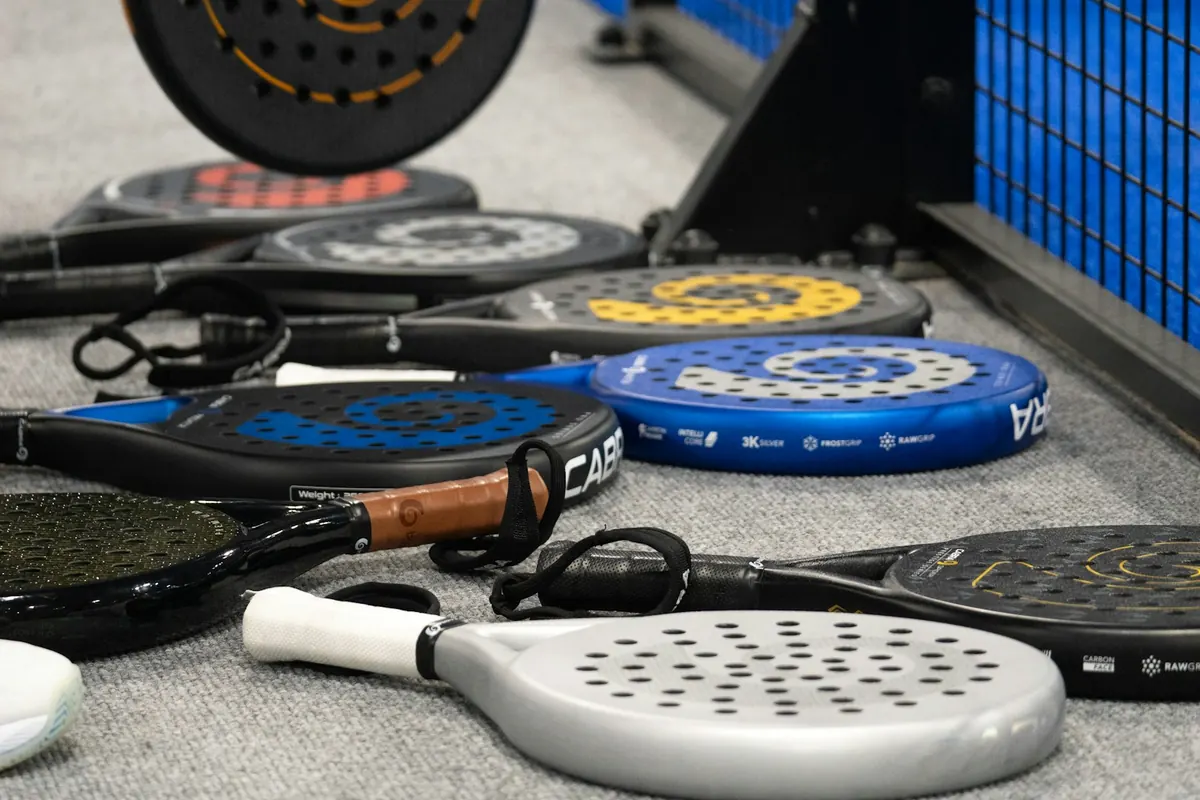
2. Weight
Padel rackets usually weigh between 345 and 385 g. Many models are sold as a range (for example 355–370 g) because the weight varies from one unit to the next.
- Under 355 g: quick and easy to handle — good for women, juniors and players with shoulder or elbow trouble.
- 355–370 g: the standard range for most adult club players.
- Over 370 g: more stability and power, but tiring over a long match.
3. Balance
Balance describes where the weight sits along the racket. A low balance (towards the handle) gives control and quick hands at the net; a high balance (towards the head) gives power but demands more strength and timing. Shape and balance go together: most round rackets are low-balance, most diamonds high-balance.
4. Core and faces
Core
The core is usually EVA rubber or foam. Soft EVA and foam cores give easy power at low speeds and more comfort; hard EVA cores give control and precision but need a faster swing to generate pace. Manufacturers describe this as the racket's feel: soft, medium or hard.
Faces
- Fibreglass: flexible and comfortable, with a trampoline effect that adds easy depth. Common on beginner and intermediate rackets.
- 3K carbon: a balance of feel and stiffness — the most common carbon option.
- 12K, 18K and 24K carbon: stiffer and more precise; they reward powerful swings but transmit more vibration.
Arm problems? Choose a round or teardrop racket under 360 g with a soft core and fibreglass or 3K faces. Avoid very stiff, head-heavy diamonds.
Recommended combinations by level
| Level | Shape | Weight | Balance | Feel / faces |
|---|---|---|---|---|
| Beginner | Round | 345–365 g | Low | Soft–medium, fibreglass or 3K |
| Intermediate | Round or teardrop | 355–370 g | Low–medium | Medium, 3K or 12K carbon |
| Advanced attacker | Teardrop or diamond | 360–375 g | Medium–high | Medium–hard, 12K–18K carbon |
| Advanced defender | Round or teardrop | 360–375 g | Low–medium | Medium–hard carbon |
See concrete models in the best padel rackets by level, or browse our rankings for beginners, control and power.
Other details worth checking
- Surface texture: rough or sandy faces help you add spin.
- Grip: padel handles are thinner than tennis grips; add an overgrip if it feels too slim.
- Wrist cord: compulsory in competition — make sure it is comfortable.
- Price: last season's model is often the best value; the changes between years are frequently small.
Coming from tennis? Read padel for tennis players before you buy — the right racket feels very different from a tennis frame. You can also compare rackets and prices on the go with our free Padel Rackets app for Android and iPhone.
Frequently asked questions
What padel racket should a beginner buy?
A round racket with a low or medium balance, a soft or medium core and fibreglass or 3K carbon faces. It has the biggest sweet spot and is the easiest to control while you learn.
How heavy should a padel racket be?
Most adult rackets weigh between 345 and 385 g. Around 355–370 g suits most men, 340–360 g most women and juniors. Heavier rackets hit harder but tire the arm and are slower at the net.
Is a diamond-shaped racket good for beginners?
Usually not. Diamond rackets carry their weight towards the head and have a smaller, higher sweet spot. They reward fast, precise swings and are best for advanced attacking players.
How long does a padel racket last?
For regular club players, the core usually starts to lose liveliness after one to two years of play. Cracks, a dead sound and less pop on smashes are signs it is time to replace it.